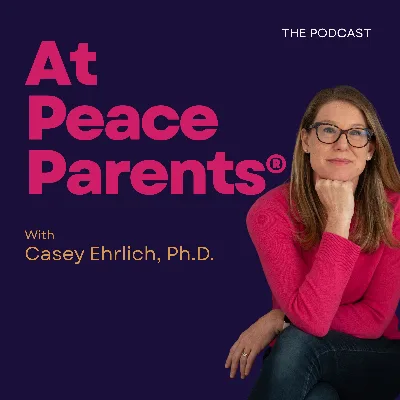
At Peace Parents Podcast
Casey Zur Website › Kids & Family · EN · 188 Folgen · zuletzt 10.11.2026
Worum es geht
Beschreibung des Anbieters, unverändert aus dem Podcast-Feed übernommen.
© 2023 At Peace Parents Podcast
Anhören
Der Podcast läuft bei diesen Anbietern — der RSS-Feed funktioniert in jeder Podcast-App.
Neueste Folgen
-

The stretch from Halloween through the new year can feel like what my husband and I call the gauntlet. More expectations, more family, more activation. And the holidays can also bring a particular kind of grief: the gap…
-
If you are worried about how much your PDA child is on screens, this episode is for you. Not because I am going to tell you screens are fine and to stop worrying. But because I want to give you a framework for…
-
What is actually happening in the brain and nervous system of a PDA child when they are in a threat state? In this episode I sit down with Dr. Amy Arnsten, a neuroscientist at Yale, to get the most scientifically…
-
Halloween is exciting. It is also activating. And if your child is in burnout, near their threshold, or simply wired in a way that makes novelty and sensory overload feel threatening rather than fun, even a holiday you…
-
Why do accommodations like lowering demands, providing autonomy, and using declarative language actually work for PDA children and teens over the long term? And why do so many parents, therapists, and teachers get stuck…
-
It is back to school season here in the US, and for most families raising PDA children and teens, that means navigating one of the most structurally activating environments their child will ever encounter. I am back…
-
Should my PDA child stay in the public school system, move to a private school, or homeschool? There is no single answer, and this episode is not going to give you one. What it is going to give you is a framework for…
-
Why are so many children and teens struggling with anxiety, depression, and school refusal right now? And why are so many of them PDA? I have been carrying these questions for years, and Dr. Peter Gray's new book…
-
What if a school had no mandatory classes, no grades, no homework, and no age segregation, and instead gave students a genuine vote in how the school runs? That is the Sudbury Democratic model, and it offers some real…
-
This episode is a throwback to one of the most popular episodes in the history of this podcast, originally recorded as a live presentation I gave in 2022 at the Miami Sudbury Democratic School. I am releasing it again…
Angaben zu den Folgen aus dem Feed des Anbieters. Abspielen beim Anbieter.
Angaben des Anbieters
- Älteste Folge im Feed
- 11/2022 · seit gut 3 Jahren
- Typische Länge
- 37 Min.
- Aufbau
- Fortlaufende Folgen Neueste zuerst, Folgen einzeln hörbar
At Peace Parents Podcast in den Bestenlisten
Für Podcast-Betreiber
Gehört dir dieser Podcast? Dann weise es nach — danach kannst du Angaben korrigieren, das Widget für deine Website holen und bekommst Bescheid, wenn dein Podcast nominiert wurde oder gewonnen hat.
Ohne Konto geht es über eine E-Mail-Adresse auf der Domain deiner Sendung — das Konto legen wir dabei an. Die anderen Wege brauchen eine Anmeldung.
Ähnliche Podcasts
 'Tis The Grinch Holiday Podcast
Audio comedy series about holiday season chaos and festive rivalries
Audible Original
 12 Hour Sound Machines for Sleep (no loops or fades)
12-hour sound machines for sleep, focus, relaxation and masking noise
12 Hour Sound Machines for Sleep | Achieve Restful Sleep, Mask Unwanted Noise, Soothe a Baby, Calm Your Anxiety
 Abide Kids Bedtime Stories
Bible stories with peaceful music and sounds to help children sleep
Abide Stories for Kids
 After Bedtime with Big Little Feelings
Conversations on modern parenting challenges, marriage and self-acceptance
Dear Media and Big Little Feelings
 Always Here
Conversations between sister-in-laws about relationships, hope and humor
Abby Howard and Abby Howard | Daylight Media
 American History Tellers
Documentary series on pivotal events and figures in American history
Audible Original
Thematisch verwandt
 Calm Parenting Podcast
Parenting strategies for strong-willed and defiant children
Kirk Martin
 The ADHD Parenting Podcast
Practical strategies for parenting children and teens with ADHD
The ADHD Parenting Podcast
 Previa Alliance Podcast
Conversations on perinatal mood and anxiety disorders affecting new parents
Previa Alliance Team
 ResponseABLE Parenting
Parenting strategies for managing strong-willed children with awareness
Becky Jennings
 ADHD Experts Podcast
Expert answers to questions from adults and parents managing ADHD
ADDitude
 Respectful Parenting: Janet Lansbury Unruffled
Weekly advice on respectful parenting approaches for infants and toddlers
JLML Press